
Simulating the Battle of Trafalgar
In a recent blog post, Eric Klopfer and I talked about how using AI to build things can provide powerful new learning experiences. One example we gave was in the humanities — we asked, “Instead of asking AI, 'Who lost the Battle of Trafalgar?', students could learn to frame more illuminating tasks: Help me make a simulation of the battle.”
In this post, we explore exactly that idea — what happens if you ask AI to help you do this, and how does it enhance (or hurt) the learning experience? We structure the post as Sam's narrative about the experience of building the simulation, and Eric's feedback on his assignment (critique of the narrative).
Sam's Narrative
Here was the prompt I started with (I used OpenAI’s Astra Model, since it had just come out at the time and was known to be good at making 3D animations):
Let's create a 3D overhead simulation of the Battle of Trafalgar. Begin with an overview of the battle: who the major players were and the situation of the navies and naval technologies that were involved. Then, do a historically accurate simulation (please research the number of boats, major phases of the battle, which boats sank, and how many people died); there should be a timeline that lets me step through the major phases or an animation mode that smoothly plays through the battle. Use attractive lighting and 3D models coupled with photographs and/or AI images to show what happened. Include links and references and short text descriptions of the major parts of the battle. Avoid excessive AI text or annotation; make it something that would be suitable for use in a class.
Prior to this exercise, I knew very little about the battle, and the simulation immediately added a lot of detail — for example, helping me place it in southern Spain, helping me see the unusual approach of two lines of ships headed straight into the line of French and Spanish ships, and showing how this allowed the British to rout their opponents by breaking through their line and attacking in close combat and from the rear, quickly disabling many of their ships. The simulation also added some context about the aftermath, when many of the damaged ships that the British were attempting to tow for salvage foundered and were lost in a storm that came up after the battle.
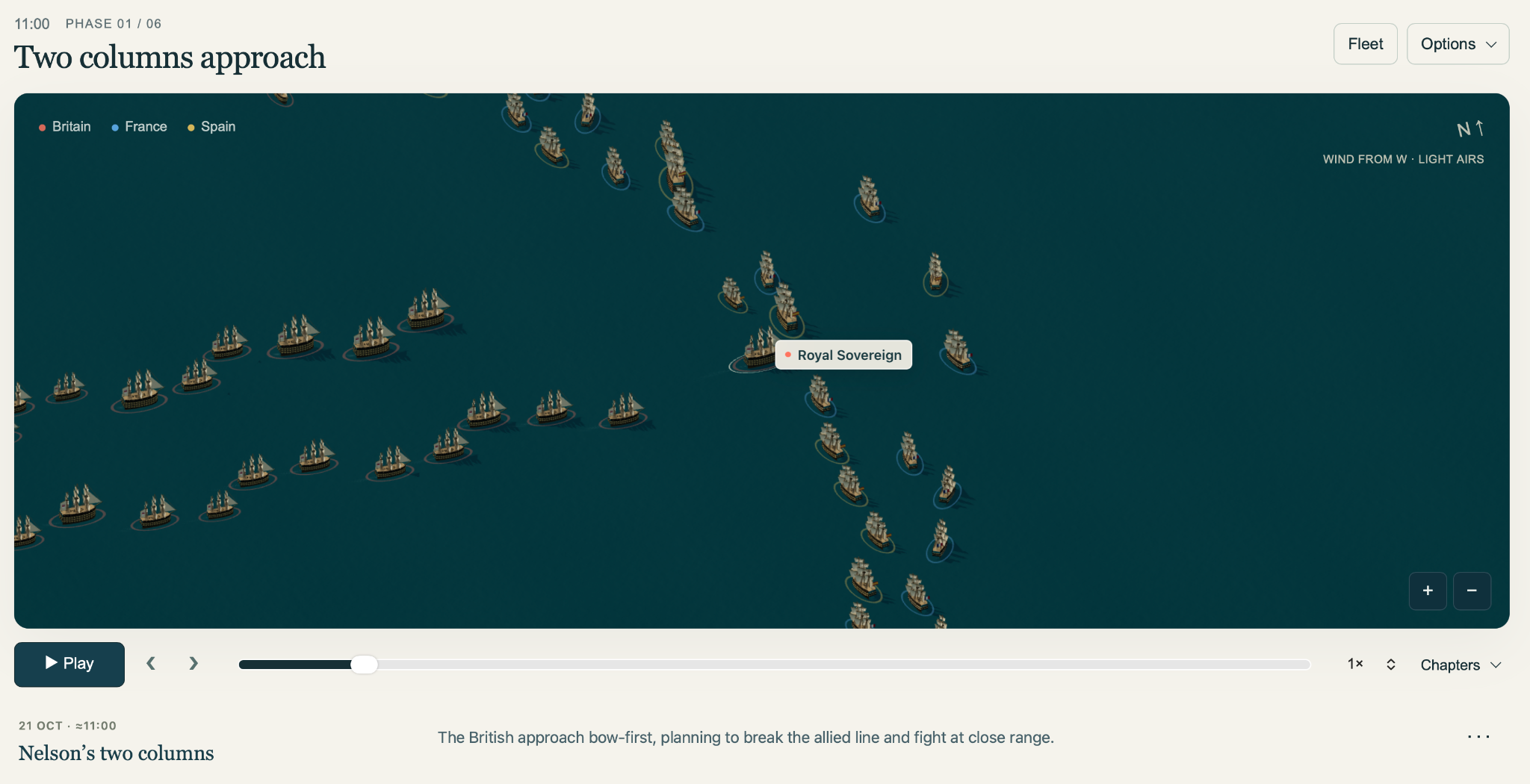
My first reactions were to the simulation dynamics: some of the visuals were overly simplified, with ship models that looked like they came from a 1990’s video game; there was a lack of visual effects like smoke and fire; ships simply passed through each other instead of colliding.
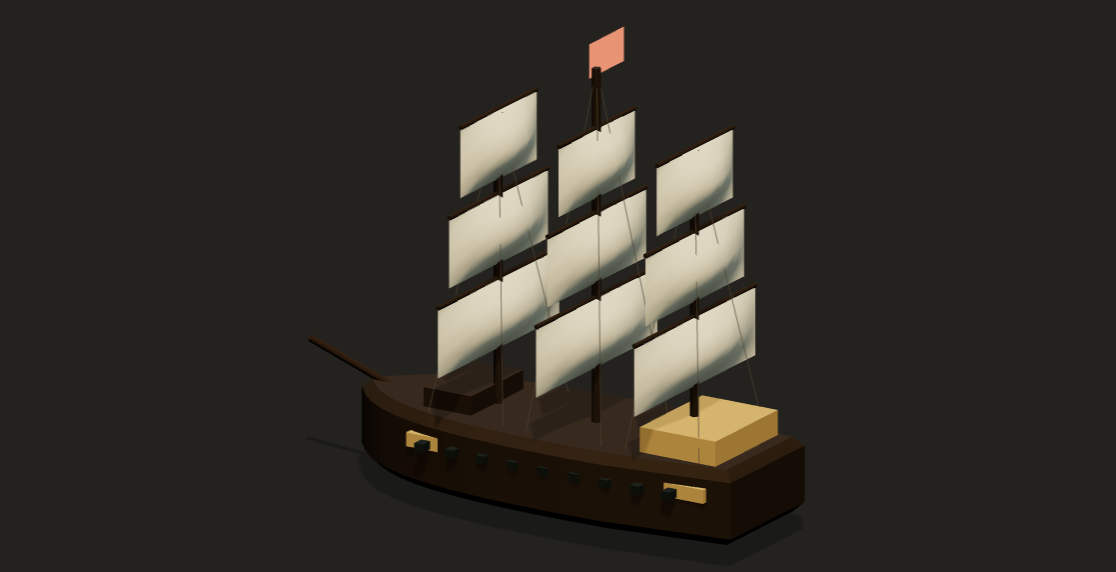
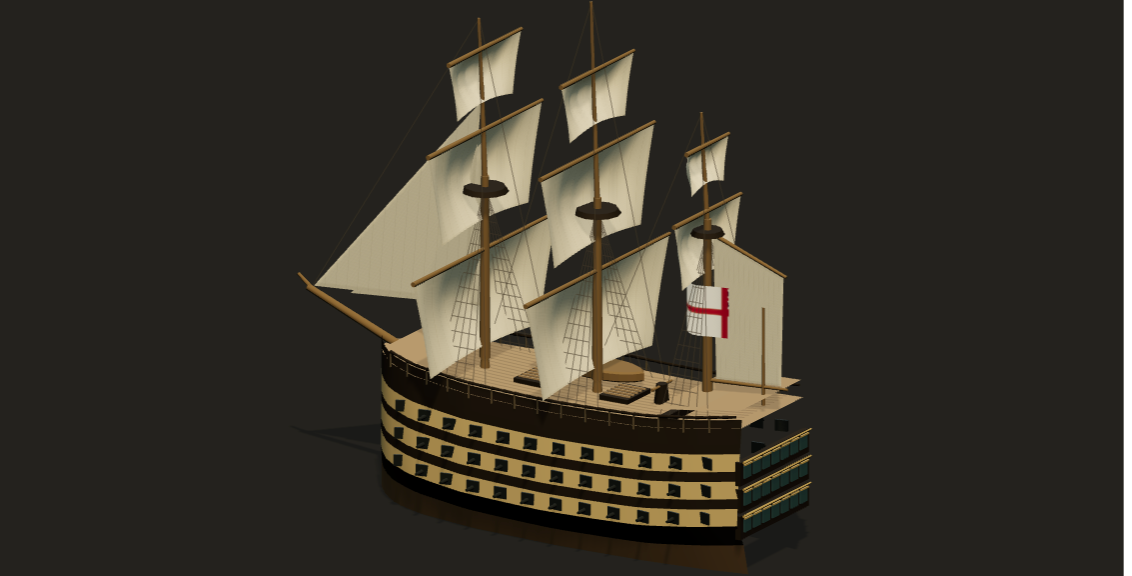
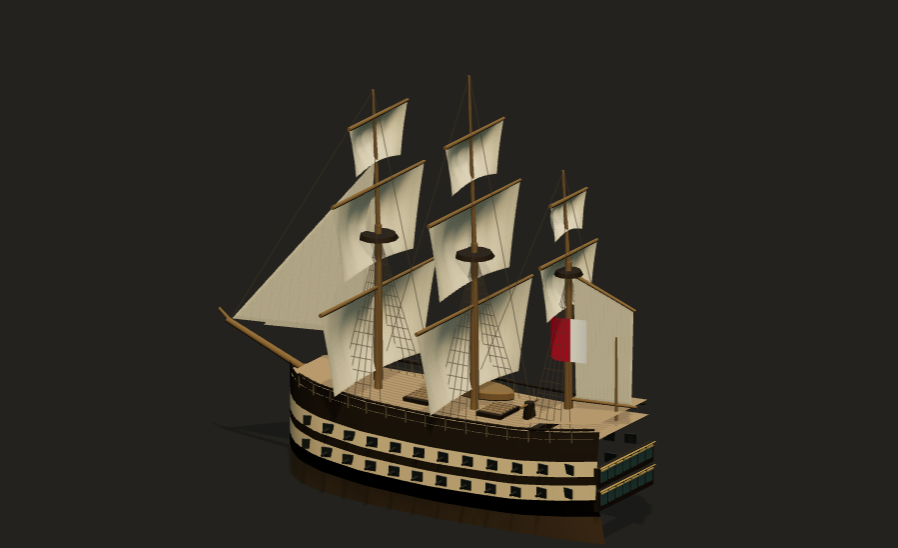
There were some other small details that I also wanted to improve — for example, I wanted to see the geography of the coastline near the battle, which it had originally omitted, so I asked it to add that, which it did:
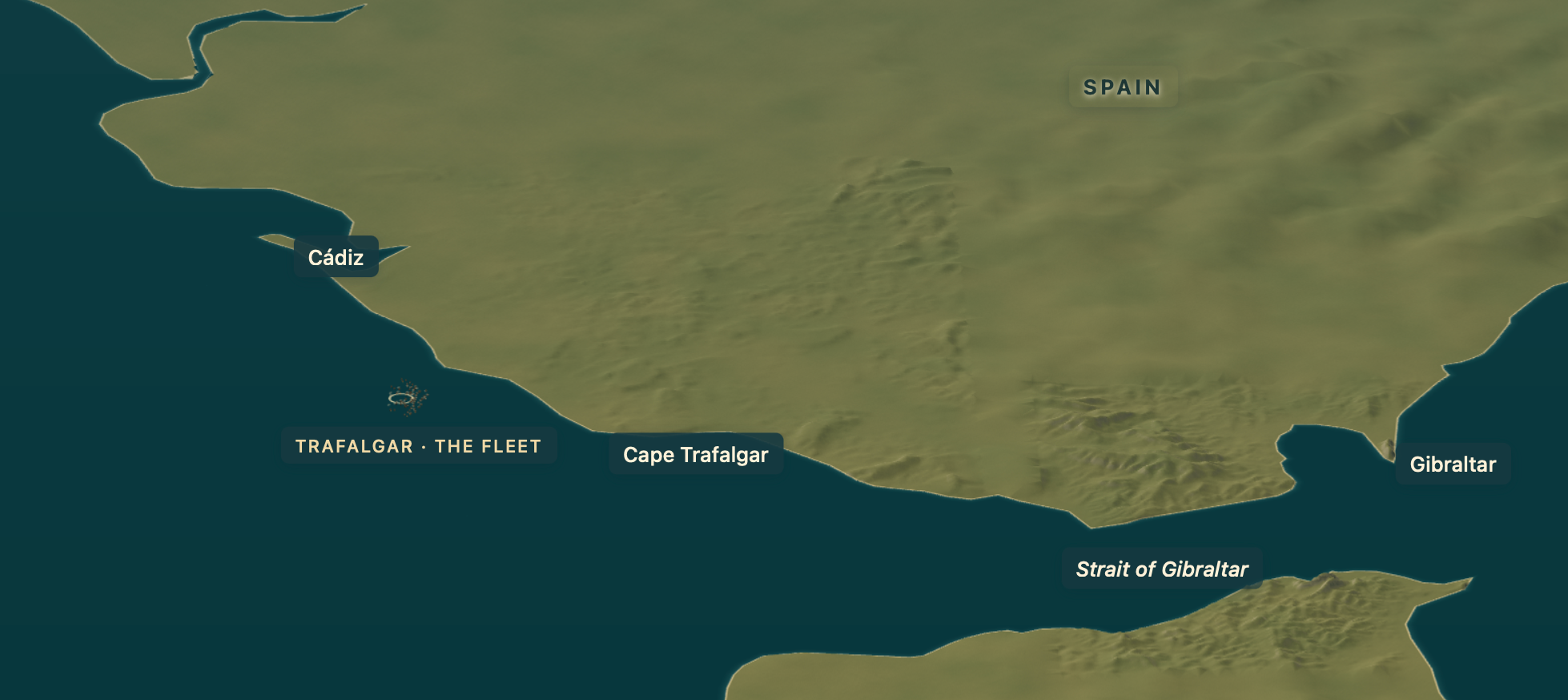
After a few rounds optimizing the appearance and exploring the simulation, I started to think critically about what it was actually showing me. The tool drew on a number of both original accounts of the battle and the Wikipedia 1 page, which gives a surprisingly complete picture of what happened: the exact ships, their captains, their positions in the lines, which ships sunk and were damaged and when, etc. The simulation accurately captured most of the detail. This is what I expected, as these models are known to be very good at following instructions and I had specifically directed it to do research and make a historically accurate simulation.
It drew on a wide variety of historical sources, including a Spanish-language catalog of Historical Wrecks 2 and various first-person accounts of the battle 345 6.
The Learning Experience
Since I am a) not an expert in this battle and b) interested in using this as an example of how AI can be used to learn, I felt compelled to dive into the details to verify what it had produced. I was most interested in the accuracy of the details of how ships engaged with each other, how they moved throughout the battle, and which ships sank.
One of the things I’ve observed about AI is that it can be ‘lazy’. Low-quality ship models and limited resolution shorelines are one example of this, but in this case it also skipped over some of the details of the battle. A few examples:
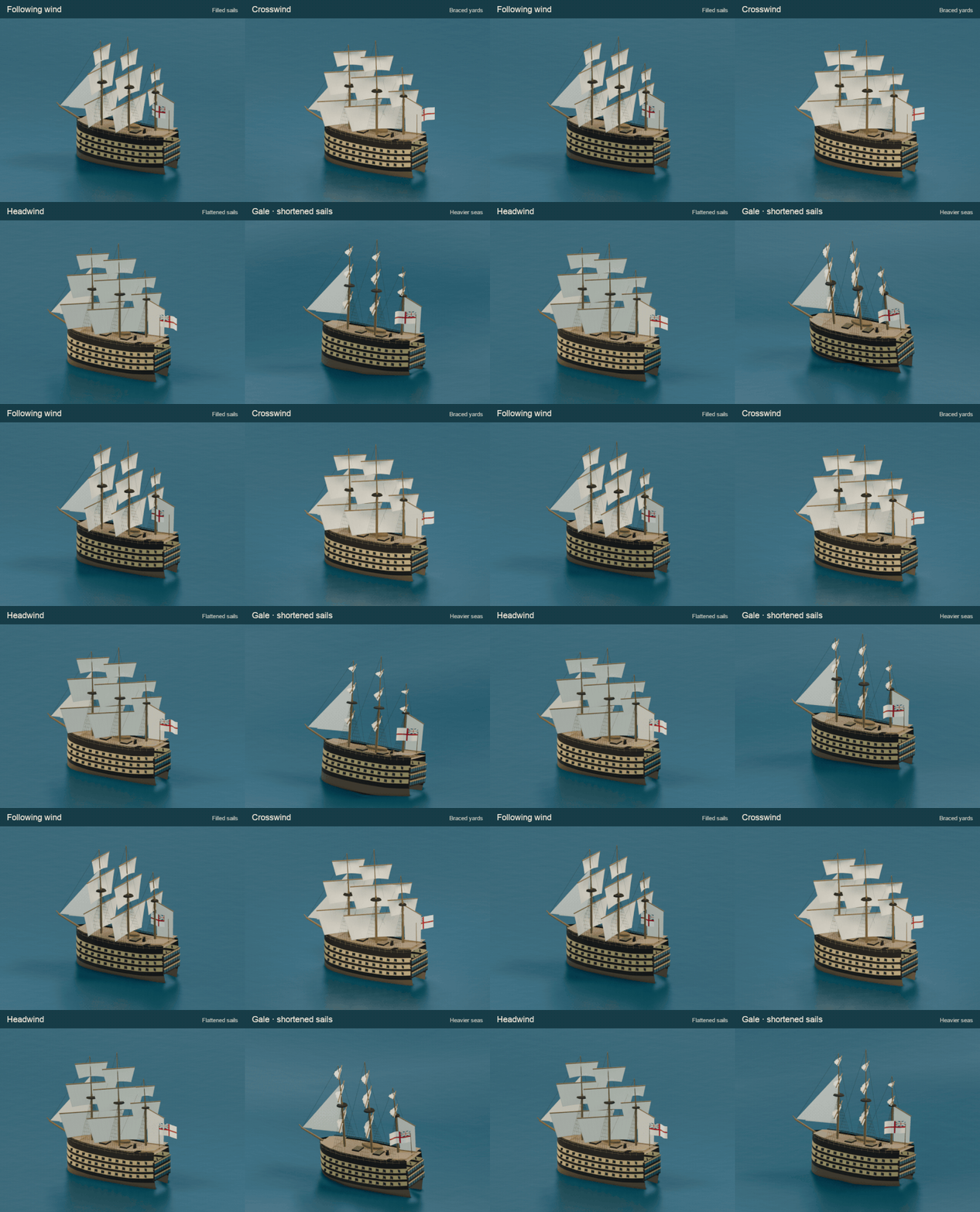
- It initially didn’t model the wind with particularly high fidelity. The ships “glided” in whatever direction they were headed, without regard for the wind. After a bit of prompting, the simulation now (somewhat) accurately models how ships and their masts behave in the wind, including the need for ships to tack when heading into the wind.
- The simulation dynamics sometimes conflicted with the historical fidelity of the battle. For example, after we instructed it that ships couldn't pass through each other, Admiral Nelson's ship, the Royal Sovereign, got "stuck" on one of the Spanish ships instead of passing through the column of Spanish/French ships and opening fire as it should have. This is one of the challenges of AI—it's good at making local changes ("ships shouldn't pass through each other"), but even the most sophisticated models aren't smart enough to go back and verify that changes don't introduce other inconsistencies with previous directives.
Here's the AI's description of what happened:
The long silent pause is a bug. Royal Sovereign reaches Santa Ana too early, gets caught on the collision boundary, and cannot fire until a later timeline gate. I’m correcting the approach so she keeps moving into the gap and fires as her broadside comes to bear.
Royal Sovereign really did pull ahead of her column, but she opened fire during the breakthrough and then fought alongside Santa Ana. I’ve slowed the early approach and am checking that she completes the turn with room to manoeuvre and her guns facing the right opponents.
She now keeps moving through the gap. I also found that firing one broadside delayed the guns on the other side, which could make her miss the brief shot into Santa Ana’s stern. The two sides now fire independently, and each shot is checked again as she turns.
- Some of the Spanish and French ships, including the Intrépide and Neptuno at first sailed away from the battle and then doubled back and rejoined it later in the day. The original simulation did not capture this motion, instead just leaving them in their original position at the northern end of the Spanish/French line, neither leaving nor engaging with the British attackers. I discovered this by asking the AI to verify the positions of all the ships according to several of the sources listed above. It stated that the movement of the Intrépide might be incorrect; the Wikipedia article about the boat's involvement in the battle notes:
On 21 October 1805, Intrépide was one of the ships of Rear-Admiral Pierre Dumanoir le Pelley at the Battle of Trafalgar, under Captain Louis-Antoine Infernet.
Dumanoir commanded the six ship vanguard of the French fleet, with Scipion, Duguay-Trouin, Mont Blanc, Intrépide and Neptuno. Nelson's attacks left these ships downwind of the main confrontation and Dumanoir did not immediately obey Villeneuve's orders to return to the battle. When the ships did turn back, most of them only exchanged a few shots before retiring.
I realized that this meant that it wasn't just the Intrépide but other ships as well that might not be placed properly, and asked the system to model their positions more accurately, which the simulation now does (although the exact historical movement of the ships is not clearly recorded anywhere).
- While the simulation accurately captured the sinking of just one ship during the battle (the French Achille), it didn’t properly model damage to the many ships, initially not showing damage at all and then showing all damaged ships in the same way, with all masts down. The historical record reflects different levels of damage to the various ships, and some later modeling got the simulation to include ships in different levels of disrepair.
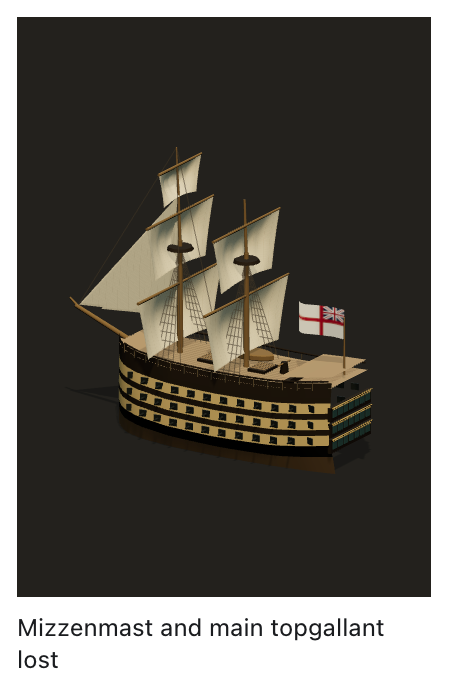
Overall, despite a few small inaccuracies, it did a remarkable job of matching the reported records of the battle; as an example of the level of detail, you can see its audit of ship damage in the simulation vs the historical record here.
The final simulation is available at: https://aieducation.csail.mit.edu/trafalgar/
AI Simulation as a Learning Tool for The Humanities
I find this to be an intriguing way to engage with history. The interactive, visual nature of the tool, and the feeling of being a "movie director" trying to match a particular feel and appearance of the ships and the battles, makes learning about the events surprisingly fun and interesting. Having to verify the accuracy/fidelity of the simulation gives a much more lasting impression of what happened than just reading a simple narrative of the events.
I am imagining assignments where instructors ask students to build interactive experiences like this and judge them on their fidelity, historical accuracy, and on the students' own engagement with the material and reflection on what they feel AI got right / didn't get right. For instructors, evaluating such assignments would be a great deal more engaging than reading many essays on the same topic.
I can imagine many such re-enactments of historical events, not just battles – for example, the Moon Landing, various civil rights protests, the building of the pyramids, or the Boston Tea Party.
19th Century European History - Professor Klopfer
Feedback on Assignment 1 - Battle of Trafalgar
I’m going to take the role of teacher/professor here, since I sort of gave Sam this “assignment”. I did that by simply suggesting that “making a simulation of the Battle of Trafalgar” could be a way to use AI. That was enough to set Sam on course to create, revise, and document this learning experience. I am not a historian or history teacher, so I’ll primarily reflect from a broader pedagogical perspective.
The fact that Sam did this not because he was particularly interested in 19th-century naval battles, but because he enjoys making things digitally, points in a particular direction for assessment design. If we want students to engage deeply with their assignments and activities, they need to care about them. One way to do that is to connect with intersecting student interests, in this case, creating digital things. Not every student will have this particular interest, but at MIT many of them will.
Sam’s reflections suggest additional learning opportunities. After one iteration of this simulation, I could ask Sam, “What do you think would have happened if the Intrepide and Neptuno engaged in the battle earlier?”, or “How susceptible to wind was the British tactic?” These are speculative questions that require not just remembering the battle but understanding it.
The simulation itself need not replace writing. Now that I’ve engaged Sam in the activity, he is happy to write about it, reflect on his own understanding, and build some of his historical-thinking skills. My colleague Kurt Squire wrote his PhD thesis on a similar idea, engaging high school students with history through the game Civilization. While they learned about some historical figures, they mostly learned and wrote about ideas about the roles of social, political, and technical systems in shaping history.
With AI, we can go beyond tinkering with existing simulations and games to creating and analyzing our own. The process of iteration and reflection as one builds the simulation and checks its assumptions allows for even deeper learning, as well as a sense of ownership and engagement. This ability to create interactive systems without a technical barrier opens up new opportunities for learning and assessment.
Notes
Part of Communities of practice