
21W.747 has students give a presentation every week and collect peer feedback on it. That feedback ends up scattered across spreadsheets making it repetitive to read and hard for professors or students to review. Metalogon turns those spreadsheets into organized records. Professors upload the Google Forms results, review rating averages, and get an AI-synthesized summary of each student's strengths and areas for improvement. They can add their own notes and track growth over time. Students get a private dashboard of their own summaries, ratings, and progress.
Why synthesize peer feedback instead of just collecting it?
Raw peer feedback in a spreadsheet is complete, but it's not usable. A professor reading eighteen students' worth of repetitive comments each week can't easily tell a student what to work on. A student can't easily track whether they're improving across presentations. Metalogon keeps the original comments one click away, nothing is hidden, but it leads with an AI-synthesized summary of strengths and improvements, plus structured rating averages. Professors can add a note and move on. Students get a progress record instead of a pile of spreadsheets.
Features walkthrough
Weeks & exercises
Weekly tracking
- Each week's presentation exercise is listed with its date and feedback-upload status.
- Professors upload that week's Google Forms results directly here.
Rating averages
At a glance
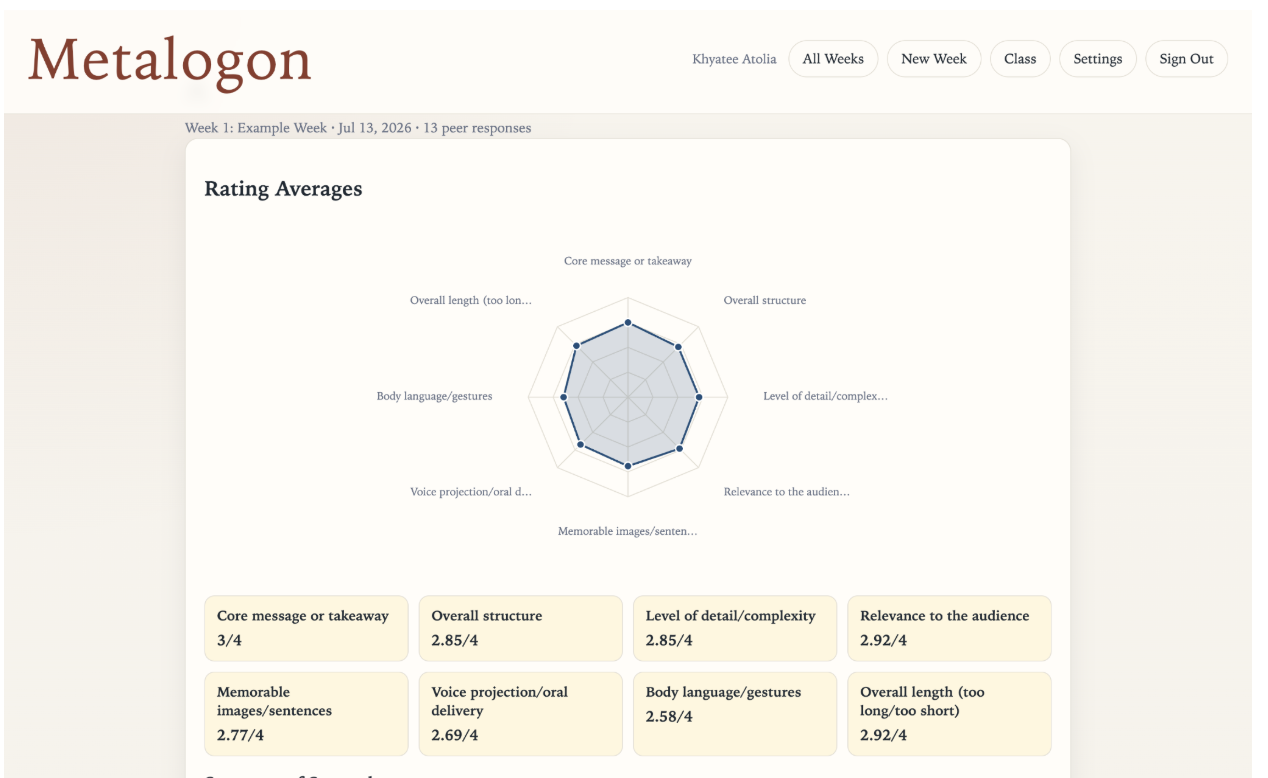
- A radar chart and score grid summarize peer ratings across eight presentation criteria.
- Averages update as new feedback comes in.
AI-synthesized feedback
For professors
- Each student gets a Summary of Strengths and a Summary of Actionable Improvements.
- Professors can add their own notes alongside the summary.
- The original, unsynthesized peer comments stay one click away underneath.
For students
- Students get a private dashboard of their own summaries, ratings, and progress.
- Growth is tracked across presentations over time.


About the course
For students with a special interest in learning how to make forceful arguments in oral and written form. Studies the forms and structures of argumentation, including organization of ideas, awareness of audience, methods of persuasion, evidence, factual vs. emotional argument, figures of speech, and historical forms and uses of arguments.