
Eulogon is a cooperative game that helps groups practice careful reasoning and productive disagreement on contested topics. This companion pairs the game's structured discussion format with an AI moderator. The moderator listens to the conversation and keeps an internal model of the group's claims, evidence, and reasoning quality. When it helps, it steps in with Socratic questions, summaries, and fact-checks, but it never supplies answers or conclusions itself.
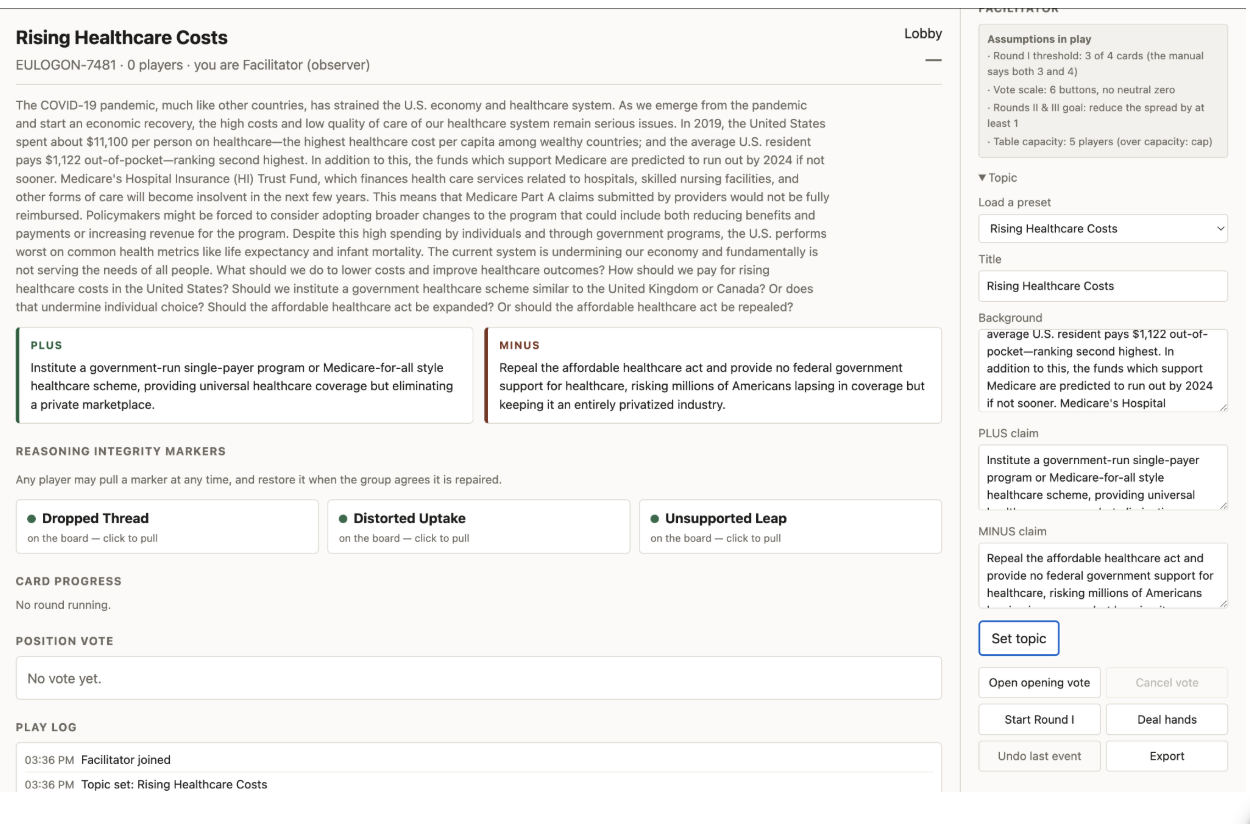
Features walkthrough
The board
A hex-grid board that shows what's happened in the game so far. You don't click or drag on it, it's just a record.
What it renders
- Each card played drops a category token onto the grid.
- The two claims sit on their anchors and advance when the facilitator says so.
- The position vote shows as pips on the printed scale.
Running a session
One facilitator, a room code, three rounds.
Setup
- The facilitator starts a session and joins as an observer. They get no cards and aren't counted in the player total, unless they choose to play a hand themselves.
- Players join with the room code and a name.
- The facilitator sets the topic, typed in or picked from a preset. It locks once hands are dealt.
- An opening position vote checks that the room is divided enough to be worth discussing.
Each round
- Hands are dealt. Players click a card to play it, confirm, and read it aloud. It joins the shared play log and drops a token on the board.
- When confirming a card, players can optionally link their reasoning to something specific. That link is just for the record. It never changes where the token lands.
- Any player can pull an integrity marker at any time, with an optional note, and restore it once the group agrees it's repaired.
- A vote closes out each round. The board clears between rounds, but the claims don't. Each claim moves one ring outward as the facilitator advances it, building a running record of the whole game.
Wrap-up
- The full session can be exported and saved afterward.
AI moderator
Listens to the discussion without joining it, and never argues a side.
What it tracks
- An internal model of the group's claims, evidence, and reasoning quality as the discussion unfolds.
- Reasoning gaps a skilled facilitator would normally catch: unaddressed objections, misrepresented claims, or conclusions asserted without enough evidence.
How it intervenes
- Asks Socratic questions and summarizes the conversation when it helps keep the discussion on track.
- Fact-checks claims raised in play, without ever supplying its own answers or conclusions.
Why does Eulogon need a moderator?
Eulogon was built to spread cooperative dialogue and healthy disagreement. But the physical game depends on a skilled human facilitator, someone who can guide discussion and catch reasoning gaps in real time: an unaddressed objection, a misrepresented claim, a conclusion asserted without evidence. Most groups discussing a contested topic don't have one on hand. The AI moderator fills that gap. It tracks the group's claims, evidence, and reasoning quality as the conversation unfolds, and it steps in with questions, summaries, and fact-checks only to keep the discussion honest. Participants stay fully responsible for the reasoning and its conclusions.


About the course
For students with a special interest in learning how to make forceful arguments in oral and written form. Studies the forms and structures of argumentation, including organization of ideas, awareness of audience, methods of persuasion, evidence, factual vs. emotional argument, figures of speech, and historical forms and uses of arguments.